How Construction Groups Should Plan Their Business

Why the project portfolio, not the annual budget, should drive resource allocation and growth
In an industrial company, construction is a support function. In a construction group, that support function is the whole business.
A model that works in a factory cannot be carried over to a group running dozens of sites. Not because construction is "special". The object of planning is fundamentally different. An industrial group has production, and construction serves it: the factory makes the product, capital construction expands capacity. A construction group has no such separation.
The project portfolio is the production line.
The portfolio is how the group converts demand into revenue, and resources into completed work and cash.
What sits beside the production system in an industrial company sits at the centre in a construction one. The annual budget follows: it stops being the plan and becomes a snapshot of it. The question is what gets planned instead.
Integrated business planning, portfolio management and resource-constrained planning have existed for years, and each works on its own. I am not inventing any of them. I propose assembling them around one object and one mechanism:
the executable portfolio of a construction group as the unit of management, and the unified resource balance as the mechanism, extended upward, to the decision to bid, and downward, to the work package.
Upward, this turns planning from managing scarcity into managing growth. Downward, it makes resource transfers between dozens of separate companies operationally workable.
Every company plans well. The group plans badly.
A large construction group brings together dozens of companies. Each plans its own resources and cash, and each is right to: cover your projects, hit your KPIs, keep spare plant against slippage. For the group this produces a paradox: the sum of local optima is not the group optimum. One company has heavy plant standing idle while another hires the same machines on the market. One holds a reserve of specialists for next month while another cannot open a work front today. One places cash on deposit while another draws a working capital loan.
Resources, data and incentives feed each other. There is little incentive to reveal spare capacity. Reveal a spare resource and someone will take it, with no guarantee that you will get it back when you need it. Hidden reserves distort the data the centre decides on, unreliable data rules out reallocation, and every company falls back on itself. Discipline and reporting do not break the circle. Changing the incentives facing the manager who controls the resource does. I come to that below.
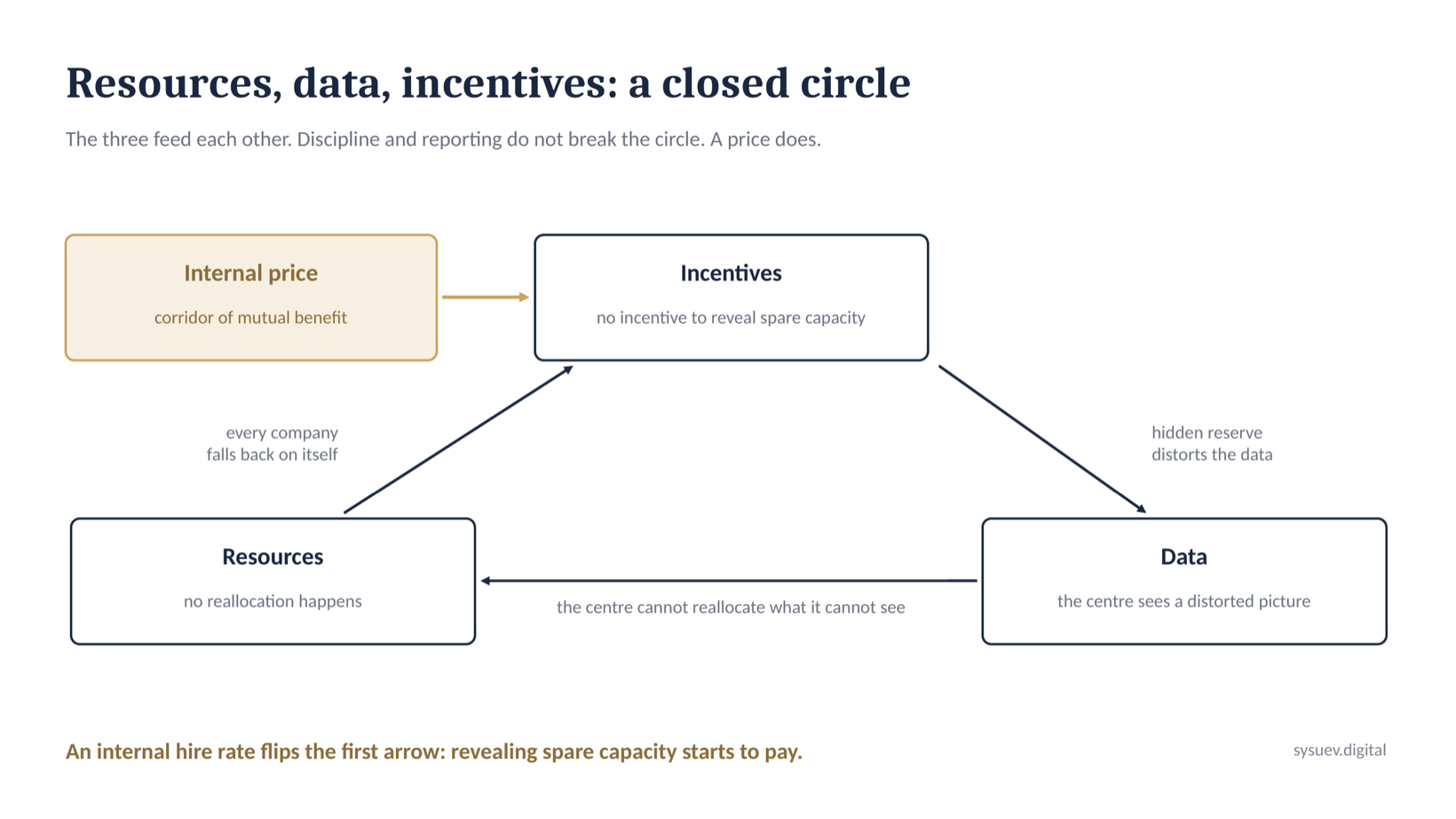
Hence my starting hypothesis: the largest efficiency reserve in a big construction group sits between its companies, not inside them.
Take two divisions. The first has completed earthworks in one section and is waiting for the structures to become available, while its piling rigs stand unused for weeks. The second has had its start date pulled forward and is short of exactly that class of machine. Both directors are rational. The first holds the plant because it may be needed on the next section; the second hires on the market because it cannot wait for an internal approval. It is the same calculation I described in the Gosplan article. The reserve is not hidden. It is simply not released. The group carries a shortage and a surplus of the same resource at the same time, and pays for the gap.
There is no demand curve, so start with the portfolio
The first monthly integrated planning cycle we launched in a construction group broke down at the very first step. The classic cycle opens with a demand review: how much the market will buy in the coming months. We sat down to calculate demand and found there was nothing to calculate.
A factory has a shipment history, seasonality, order statistics. A construction group has a bid pipeline: a tender with a win probability, a decision date, an expected start, a resource profile and, if won, a programme running years ahead. It is a set of bets that either materialise or do not. There is no smooth demand curve.
So we replaced the demand review with a portfolio review. The cycle now opens with two questions: what are we committed to deliver, and how much of it is covered. Port a ready-made monthly cycle into construction and this is the step to change; the rest falls in behind it.
Planning in a construction group runs on two axes. The first is the project axis: bid, contract, design, mobilisation, construction, completion. The second is the portfolio calendar: what the group as a whole will be doing over the next 12 to 18 months. Every monthly cycle is where they intersect: what is happening to each project, and what that means for the portfolio.
A project should not be bent to fit a fixed annual budget; its planning detail has to match its stage. Early on the uncertainty is wide and asymmetric: the saving is limited, the overrun can be large. As detailed design and issued-for-construction drawings advance the corridor narrows, but the skew towards cost growth remains. Demanding the same accuracy from a tender and from a site already in construction manufactures precision that does not exist yet.
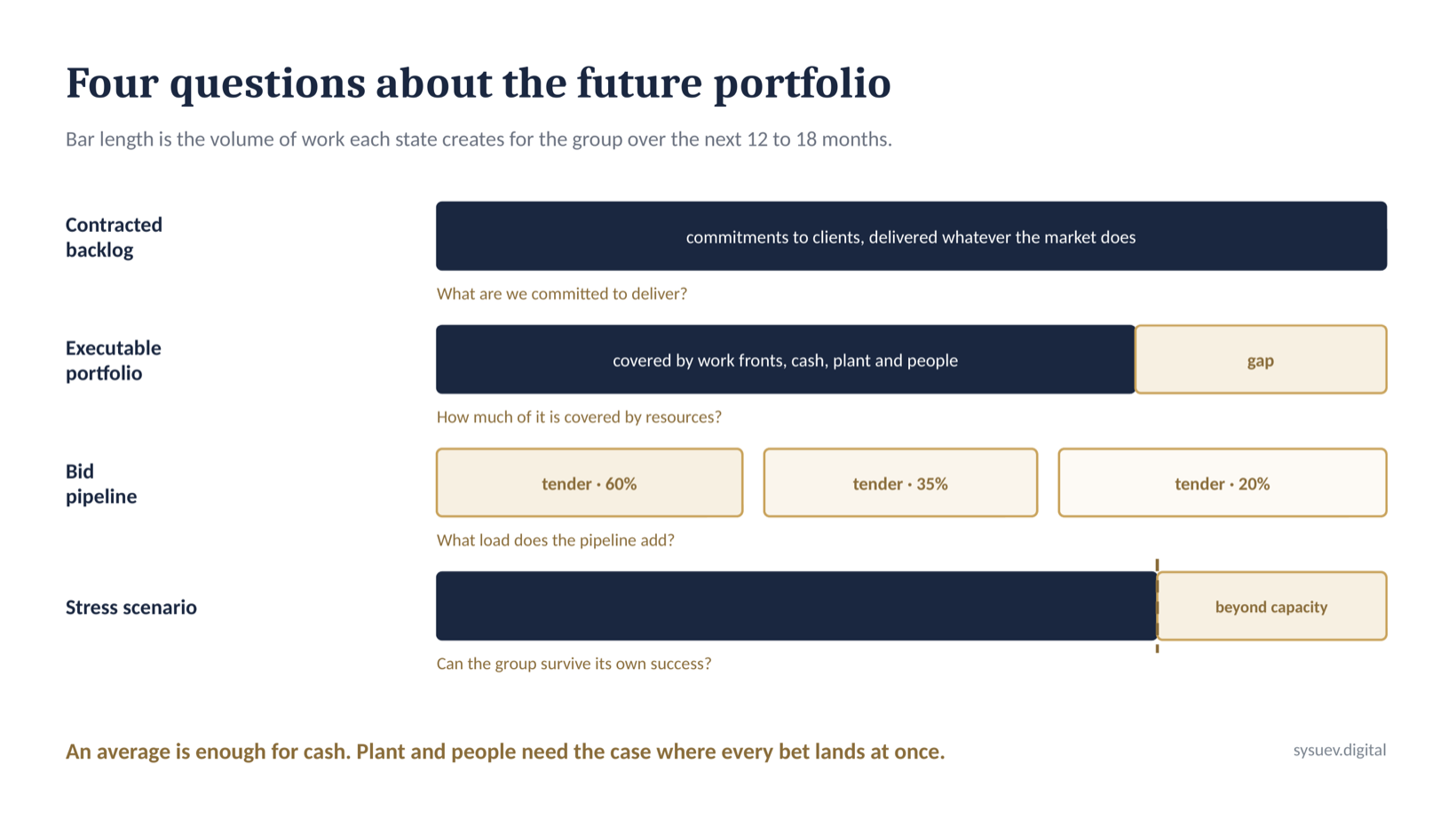
The future of the portfolio cannot be described with one figure. It takes four questions.
What we are obliged to deliver. The contracted backlog. The work the group is contractually committed to deliver, whatever the market does tomorrow. Order backlog or order book, depending on whose accounts you are reading.
How much of that is covered. The executable portfolio. The part of the contracted backlog that the group can actually deliver with the resources available when they are needed. Overlay the portfolio calendar on availability for each critical resource class; any month where the requirement exceeds availability, external hire included, is uncovered. The gap is future risk to programme, cost and contractual commitments. Close it with external resource, renegotiate the dates, or escalate it to the portfolio committee. First, see it.
What may be added. The bid pipeline. What has not been won yet. Probability weighting does the work: a project with a 30 per cent win probability carries the corresponding expected load. Russian public procurement, governed by 44-FZ and 223-FZ, gives the funnel a different shape: it lives through procedural shocks. A complaint to the Federal Antimonopoly Service can suspend the award process. A single-source procurement opens a contract with no competition. Contractors may bid for work they do not particularly want simply to preserve their eligibility for future tenders, which bends the win statistics. Volatility comes from the procedure as much as from the market, and it cannot be averaged away.
What happens if it all arrives at once. The stress scenario. Probability weighting gives a useful base picture for a financial forecast. For resources one average is not enough: a piling rig is either available in the month you need it or it is not, and a crew either mobilises or it does not. You also need the scenario in which every large bet lands at once. That produces an unusual question for a board. Can the group survive its own success?
The resource balance belongs in the bid decision
This step is usually skipped. The commercial team decides whether to bid, and operations deals with the consequences after the win. For a large construction group that is too late.
If a potential contract calls for scarce plant, a rare qualification, or overloads a critical resource in the same period, that should be visible before the bid goes in. So the unified resource balance becomes an input to the bid decision, at the body that already exists: the bid committee. Five options follow. Bid and rely on internal resource. Bid with external hire priced in. Move resource off another project. Change the programme offered. Decline to bid.
The practitioner's objection is obvious. You have two weeks to decide, no detailed design, and no time to build a full resource profile. You do not need one. A high-level profile of five to seven critical resources, derived from standard productivity assumptions against the tender quantities, takes a day or two. That is enough to see peaks overlapping.
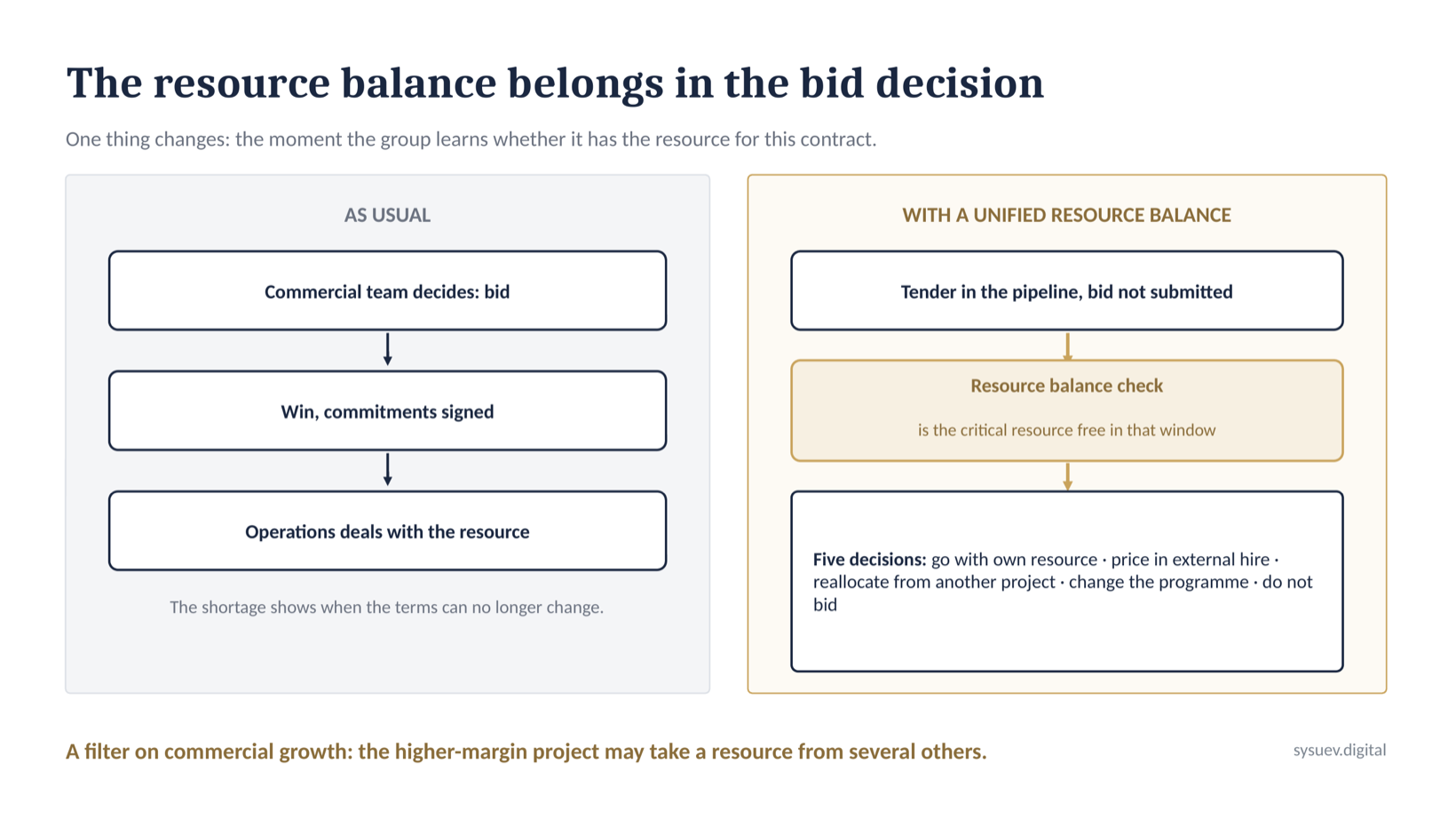
The resource balance stops being only an execution system. It becomes a filter on commercial growth. You can win more tenders and earn less. You can also give up revenue deliberately and raise the profitability of the whole portfolio. The project with the larger absolute margin is not automatically the better one if it consumes a critical resource that could have worked across several others. For scarce capacity the right question is different: what return does each unit produce?
Cash has a radius of zero. Equipment does not.
The group's resources behave differently: cash, plant and equipment, temporary works and specialist temporary structures for bridges and viaducts, site establishment, materials, people, design capacity. Cash pools most easily, then plant and formwork systems; materials are harder, and people follow a model of their own. The principle holds throughout: plan a resource against the whole group portfolio, not against one company's plan.
For plant I would separate three layers. The core is what a subsidiary needs for contracted, well-understood load, and it stays with the business: excavators, dozers, articulated haulers, rollers. The shared buffer covers variable rather than permanent load, managed centrally and free to move between companies: mobile cranes, piling rigs, telehandlers, pumps. The strategic pool covers future large projects, rare machine classes and long-lead items, and must not dissolve into current workload: tunnel boring machines, launching gantries, form travellers, large crawler cranes, batching and asphalt plants. Three economic roles for a resource, not three accounting categories.
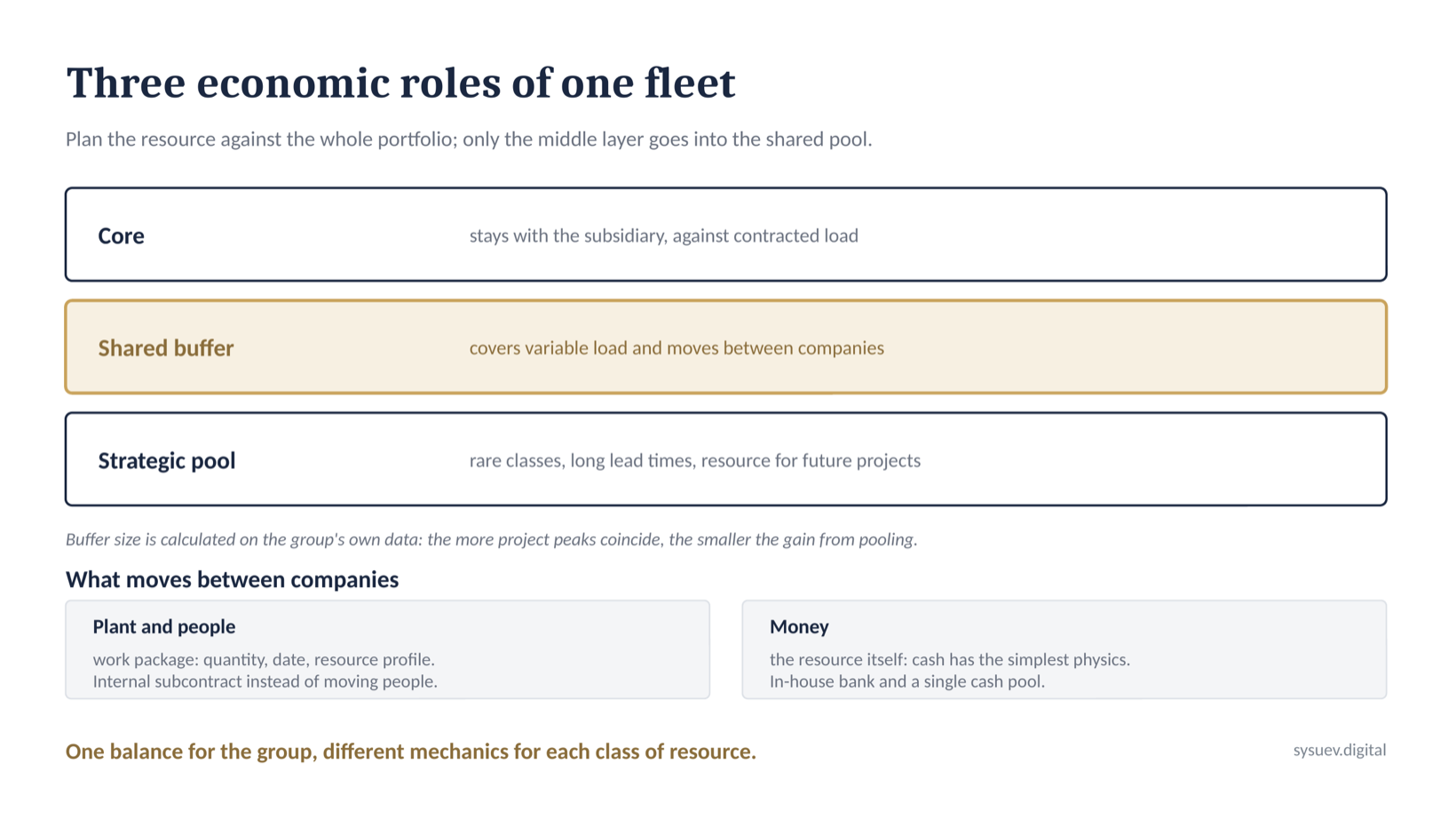
The size of the shared buffer cannot be set by feel. It depends on how independent the demand peaks of different projects are. Inventory theory has a familiar rule: with independent demand, the reserve required grows roughly with the square root of the number of stocking points. An analogy from a neighbouring field, not a theorem about piling rigs. In a real portfolio the effect is smaller, because projects correlate and seasonality bites; the real number is calculated on the group's own data.
Geography needs an honest caveat. Cash can be moved almost instantly and at negligible cost. Plant cannot. Haulage on a low-loader, abnormal load permits and escorts, crane erection and dismantling, and shifts lost on the road eat the gain quickly. A practical rule of thumb is to move a machine only when the total relocation cost is comfortably below one or two weeks of equivalent external hire. The unified resource balance is therefore assembled from several regional pools of different permeability, and the buffer calculation counts demand points inside one radius, not companies in the group. Each group works out that radius on its own data; it decides where the pool ends and external hire begins.
A pool does not remove scarcity. It monetises differences in timing.
What moves between companies, then? Either the resource itself, a machine, a crew, a cash limit, or the work. At the scale of a large group, physically moving assets between legal entities becomes an administrative exercise that eats the gain, so for plant and people the more practical unit of reallocation is the work package: earthworks on section X, quantity Y, by date Z, with a defined set of machines and crews. It can be planned, resourced, transferred, priced, controlled and tied to a project. It matters most for people: the engineering core and key staff stay in their own companies, and what moves is volume of work, internal subcontracting rather than transfers of personnel.
The work package is the unit of planning and reallocation; legally, what passes between companies is either the work or the resource itself. That transfer is only relatively easy. Internal subcontracting means a contract with a price, VAT, acceptance, warranty and monthly paperwork on prescribed forms: the KS-2 and KS-3 certificates, broadly equivalent to interim payment documentation in UK construction. The receiving company must hold the approvals the work requires: licences, hazardous-facility permits, welder attestations. SRO membership attaches to whoever contracts directly with the client. Some public contracts cannot be passed on at all, because they carry a personal-performance requirement or a mandatory share for small and medium-sized enterprises that a subsidiary cannot fill. There, only hire of the resource works, and internal transfers are normally operated hire rather than dry hire: the machine moves and the operator stays on the donor's payroll.
For cash the mechanics run the other way: money has the simplest physics, and it is easier to move the resource itself. Inside a group this is cash pooling with an in-house bank. Placing spare liquidity into the pool beats a deposit, drawing from it beats an external loan, and a group where one company holds a deposit while another draws a working capital loan is paying to keep its cash in two pockets. The constraints are hard: ownership structure, tax regimes, covenants. Money under treasury servicing is excluded entirely. There is no simple Western equivalent: it stays ring-fenced to the specific contract and cannot be swept into the group pool. Work out the share of such money in advance, or the pool will be half the size you expected.
A group has one balance. Every class of resource has its own mechanics.
Let prices coordinate the routine
Earlier in this series I argued that the centre needs the decision rights to move resources between subsidiaries, and that economic feedback matters more than centralisation. But you cannot take every machine to the portfolio committee. Routine needs rules: an internal hire rate, priorities, lead times, a service level, return rules, compensation for the owner, standing charges, terms for going outside. The internal price is those decision rights turned into an everyday rule.
The internal hire rate has three boundaries, not two. The floor is the donor's owning and operating cost; below it, releasing the machine loses money. The ceiling is the recipient's external alternative; above it, the site goes to the market. The third is usually forgotten: the plant cost allowance embedded in the recipient's contract rates, priced on the machine-shift. If the internal hire rate exceeds that allowance, the site goes into the red whatever the group gains. The contract is let at a firm price, and unlike an NEC compensation event, no contractual mechanism lets the contractor recover the difference. Where the third boundary falls below the donor's cost, the portfolio centre closes the gap deliberately rather than leaving it on the site budget. Otherwise the recipient refuses the internal resource.
A rate alone is not enough. In the scene above, the director holds the machine not because nobody pays for the idle time, but out of fear that it will not come back in time for their own peak. The rate compensates owning and operating cost. It does not compensate that option. Three rules sit alongside it: a right of recall by a date announced in advance, a booking fee for whoever reserves resource against a future peak, and target setting that does not build on last year's outcome. Without the last one the old ratchet runs: reveal a reserve, receive a higher plan.
The arithmetic facing the subsidiary director has to change too. Until it does, holding on is the right call. Transfer income is credited to the donor in full and does not reduce the donor's own target. The recipient pays out of its own budget. Return on time becomes a metric in its own right. Standing time on the donor's site caused by a late return is charged to the recipient. Four lines in the bonus policy do more for the unified resource balance than any system.
Tax is not a detail. Transfers between related companies must be priced at arm's length, and VAT arises on each one. If some group companies operate under the simplified tax regime and cannot recover input VAT, an internal transfer can be economically worse than an external hire. Savings are counted after tax, or part of the effect exists only in the presentation.
The right to say no has to survive. If the group plant company cannot supply a machine on the date required, the subsidiary must be able to go outside. Without that, the internal rate becomes an administrative monopoly. That is the line between this model and bad centralisation: the central resource has to compete to be chosen. Where the right of exit is limited, by the contract's resource list or by treasury servicing, a service level fixed in the rules and a right of escalation take its place.
Two objections will be raised in the room. Does the group plant company become a monopoly? The answer is the right of exit, and a published rate card instead of a negotiation on every deal. The second is more serious. Are we recreating the soft budget constraint described by Hungarian economist János Kornai, which drained meaning from every internal price in that economy? Internal rates do not answer that. A rule announced in advance does, under which the centre stops funding a loss-making subsidiary. Until it exists, the internal price is an accounting entry, and the group pays either way.
A third objection comes from people who have been in the industry a long time: we had this already, it was the mechanisation department, and we moved away from it. For good reason. It billed machine-shifts above market rates, failed to deliver on time, and the site had nowhere else to go. The difference comes down to two things, both listed above. The rate is capped by the external alternative and by the plant cost allowance, and the site can go to the market. Without those two limits you rebuild the same central plant division.
A pool needs an owner, and the owner has a price
There are three roles. Subsidiaries own their production and their core resources. Accountability for the project result stays with them; a pool changes how a resource is obtained, not who is accountable.
The group plant company holds the shared buffers: register, availability, rate card, service level, dispatch. It can be a separate company with a common fleet, the mechanisation base in a modern form, or a virtual pool, where machines stay on the subsidiaries' balance sheets and only the availability register and the decision rights to move them sit above.
The portfolio office runs the cycle: one portfolio model, the calendar, the resource balance, the scenarios, and rate methodology together with finance. Exceptions, strategic priorities, conflicts and large reallocations stay with the portfolio committee. Whoever holds the resource, the balance must not become one more functional silo. Operations would optimise utilisation, finance liquidity, the project office dates; the unified resource balance sits by definition between those interests.
The pool has a price of its own: running the plant company, request turnaround, accounting and rate methodology, liability for the condition of transferred machines. Compare real decentralisation against a real pool: on a small fleet the gain may not cover those costs.
Two of Europe's largest contractors have answered this question differently. Strabag runs an internal plant company, BMTI: by its own description, intra-group dispatch, hire, maintenance and repair of the group's construction machinery and vehicles. VINCI is organised differently: a decentralised group of thousands of business units. It publishes no single group-wide equipment company equivalent to BMTI; plant sits inside the divisions, with VINCI Construction Grands Projets, for example, running its worldwide fleet through its own internal equipment management tool. The right organisational design depends on the structure of the portfolio, not on which company you copy. The formwork and falsework hire market shows where pooling almost always works: where the kit is standard. For temporary works designed for one specific structure, only the component base pools: sheet piles, modular truss and panel systems, props and falsework.
Even a good pool has a bottleneck
Even a good pool does not make resources infinite. At any moment the portfolio has one resource that starts to limit growth first: a class of plant, a rare qualification, design capacity, readiness of work fronts, cash. Eliyahu Goldratt's theory of constraints made the point decades ago. Maximising the utilisation of everything else is pointless; find what will stop the portfolio first, and manage that. If the whole portfolio has plant cover but a shortage of coded welders limits output, more machines add nothing. For the constraining resource, the earlier question is the operative one: what return does each unit produce? Fill it with the work that generates the highest contribution per constraint hour, and choose tenders on the same logic.
A unified resource balance exists to reveal, in advance, the constraint that sets the pace of the whole portfolio.
So where does the annual budget go?
Construction takes to an extreme something that holds for any large business. A living plan is a rolling horizon, 12 to 18 months for example. Every month it is rebuilt from the current plans of active projects, the contracted backlog, the probability-weighted bid pipeline, the plans of support functions, resource availability and cash profiles.
The annual budget is a snapshot of that plan on a given date. It is necessary, and it should not become a second, independent plan. The board, covenants, tax, dividends and external reporting all need an annual number. Portfolio management does not.
If a client moves a large project four months to the right tomorrow, the reflex should not be "first we change the budget". The chain runs differently. The project programme changes, the resource profile changes with it automatically, the portfolio is rebuilt, decisions are taken on plant, people, procurement and cash, and a new annual snapshot is drawn from the new plan.
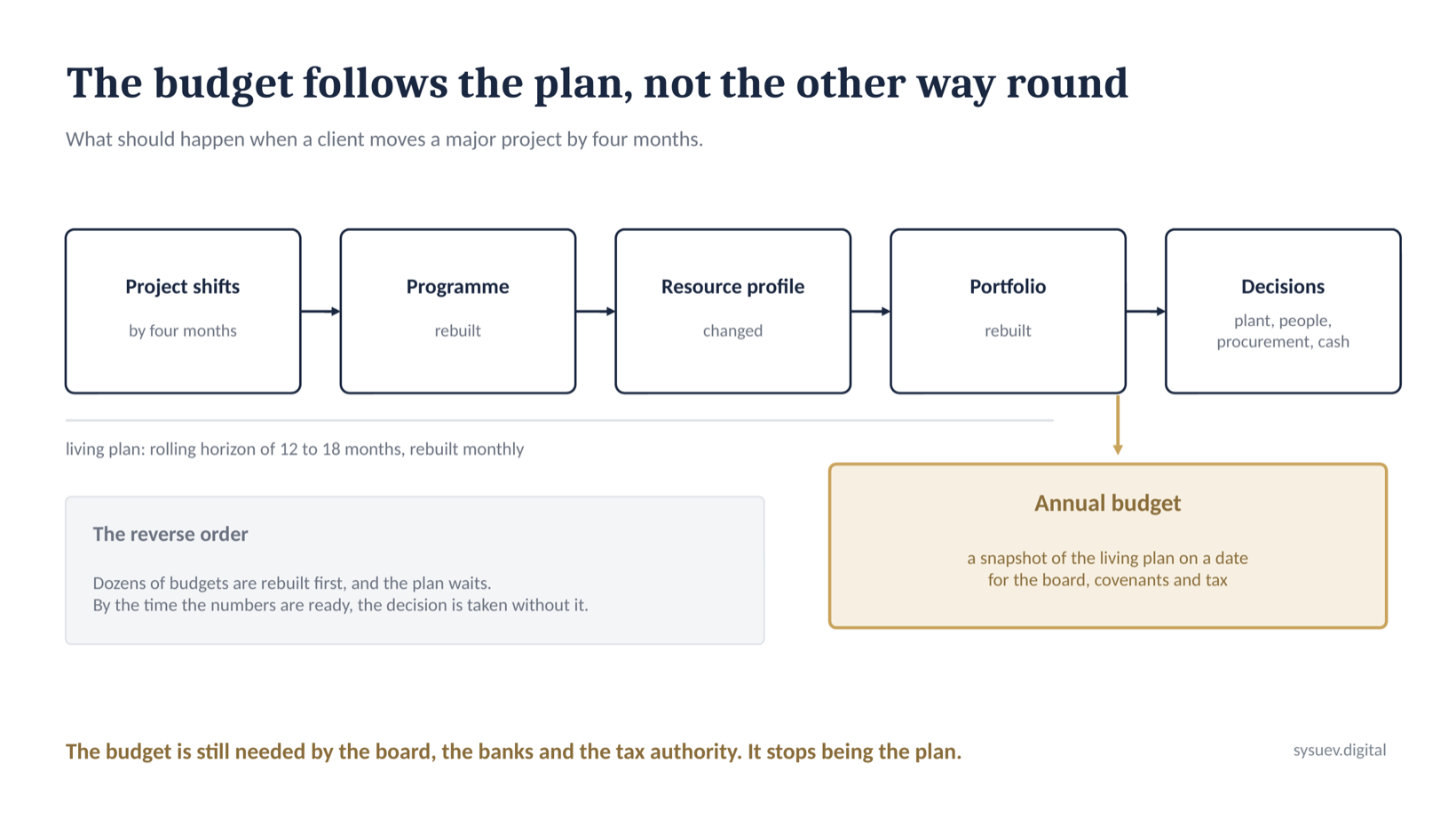
The budget should follow the plan. Not the other way round.
Russian rigidity here is real and should not be glossed over. A firm-price public contract and treasury servicing are not suspended by a rolling plan. Outside the group perimeter, obligations change through a formal procedure, by supplementary agreement, and only in the cases the law expressly allows, such as a material rise in resource prices. The living plan governs everything inside the perimeter: resources, dates, cost.
There is a further distinction, and it matters more than the calendar. You can recalculate numbers every month and still plan nothing. A system that reports "here is what the future looks like now" describes; it does not plan. So I would separate three levels. The annual budget is slow and descriptive. The rolling forecast is faster, but may still be descriptive. The living portfolio plan is fast and directive: its job is to change the allocation of resources towards the portfolio's future target, not to describe what has settled. That is where integrated planning stops being management reporting.
So a construction group should not have one "plan". It has several connected levels, and this table is where both axes meet, the project axis top to bottom and the portfolio axis left to right. Above the table sits a strategic portfolio on a three-to-five-year horizon: where the group is growing, and what capacity and capabilities it is building to get there.
| Cycle | Horizon | Core question |
|---|---|---|
| Portfolio integrated planning | 12 to 18 months | What portfolio can we actually deliver? |
| Project plan | Project life cycle | What has to happen on this specific site? |
| Programme and schedule management | Months, weeks | Is the programme resource-loaded and synchronised? |
| Work front and work package plan | Week, day | Are the fronts resourced for this week? |
| Actuals and weekly commitments | Day, week | Did we deliver what we promised? |
They must not be mixed. The portfolio should not run the daily work allocation, and the daily work allocation should not set portfolio strategy. But a continuous link has to run up and down between them: the project changes, the portfolio changes, the resource balance changes, project decisions change.
The bottom level deserves a note. The weekly loop on site has long been a system of promises: a crew takes on only the packages whose constraints have been removed, and the share of promises kept is measured as Percent Plan Complete. That is the Last Planner System, and in most groups it lives inside individual projects. I add one thing. The reason for non-completion should travel beyond the site manager, up to the portfolio. Five projects in a row reporting "the plant never turned up" is a portfolio signal about which class of machine will hit a ceiling next quarter. Two conditions. The promise is made by the person doing the work, not issued by a dispatcher. And Percent Plan Complete should be read alongside the number of tasks made ready and the volume of commitments taken, and the reasons for variance. Without that, the metric improves by promising less.
The model on one page
Put together, this is what I call the project-resource balance. It belongs in the operating model, not in the tool stack. The unified resource balance is the mechanism, and the group's executable portfolio is the result it is assembled to produce.
The project is the primary planning unit. The portfolio is the primary management object.
The contracted backlog shows guaranteed load, the executable portfolio covered load, the bid pipeline probable load, the stress scenario the ceiling of capacity. The resource balance connects the projects to each other. The work package is the unit of planning and reallocation; what passes between companies is the work or the resource itself. Internal prices coordinate the routine, the portfolio committee decides the exceptions. The rolling plan lives every month, and the annual budget is a snapshot taken from it.
The effect has two layers. Inside companies it comes quickly and stays limited: less standing time, higher utilisation, less inventory, fewer emergency purchases. The scale comes from between companies, where the same resource stands idle in one part of the group while another hires it on the open market.
Success is measured by four things, and the number of planning meetings is not among them. Unresourced backlog, the value of contracted backlog that is not yet resource-covered over the next twelve months and how it moves month by month, is the single best measure of the model. Decision latency, from the early warning or the variation notice to the changed plan on plant, procurement and cash. Avoided external hire spend, valued at the external hire rate on the date of the deal, since the internal hire rate is set by the party being measured. And pool service level: the share of internal requests fulfilled on time and in full, OTIF, without which the pool dies of mistrust on the third refusal.
Fleet utilisation is not a metric on its own. It is calculated three ways, time, financial and on-hire, with results that differ by multiples, and it rises partly through work on low-priority sites. It acquires meaning next to contribution per constraint hour. Calculate the economic effect on the pilot scope's data, and fix the baseline before the start rather than reconstructing it afterwards.
Where to start
Not with the whole group. Start with a pilot across three to five companies, one class of scarce plant and one region where the movement radius clearly works. And be honest from the outset. The group probably has no single availability register: every company has its own classifiers, running hours live in driver logs, nobody formally assesses technical condition, and a reference catalogue and a standard transfer contract will take the first few months. The owner of the change is the chief operating officer, or whoever runs the business day to day. Finance owns rate methodology. A project handed to the planning department or to IT dies.
And the most important point. The unified resource balance has to start influencing a project before that project is won. That is when it becomes a mechanism for managing growth rather than for managing scarcity.
Planning changes the present, not the future
The job of planning is not to describe the future as precisely as possible. Its job is to change the present early enough to produce a different future. For a construction group, integrated planning ends where portfolio management begins. The unified resource balance connects those two worlds, and the executable portfolio of the whole group is the result it is assembled to produce. It works only when extended in both directions: up, to the decision to bid, and down, to the work package.
Five questions to take to your next portfolio committee
Take one thing from this article: these five questions. Answering "yes" proves nothing. Each has a checkable fact or a date behind it.
1. Ask for the portfolio's resource profile for March next year, across three critical resources. How many days will it take, and from how many files?
2. When did you last walk away from a tender that priced well, because you did not have the resource? Name it.
3. For last year, put two numbers side by side: what the group paid for external plant hire, and how many plant hours stood idle in its own fleet. Have they ever been on the same page?
4. How many days passed between the last major date change by a client and the moment decisions on plant and procurement changed? Not the report update. The different decision.
5. What does a subsidiary director lose by handing a machine to a neighbour, and what do they get for it?
If the first half of the answer to question five is longer than the second, the pool will not work, whatever software you put around it. And if there is no answer to question four, the problem is no longer the quality of your budgeting. You simply do not have a living portfolio plan.
This continues my series on integrated business planning. The earlier articles cover which planning cycle should become the primary one in a large group and why economic feedback matters more than centralisation itself.
Next: the economics of honesty. Why a subsidiary is rational to keep an idle resource, and how to write rules that make disclosing that reserve, and releasing it where it creates more value, the better deal.